Jazz Theory · Harmony & Voicings
The Jazz Theory Book
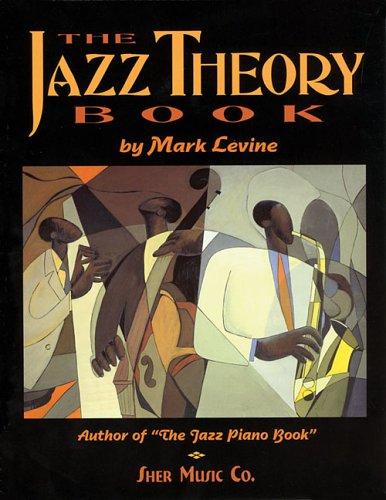
Still the default jazz theory text thirty years on — encyclopedic, musical, and built from real recordings, as long as you treat chord-scale theory as a map, not the territory.
The bottom line
If a student asks me for the jazz theory book, this is still the one I name first — and then I immediately add two caveats. That’s been my answer for years, and Levine’s brick of a book has earned it: over 500 pages that systematically walk from “what is an interval” to Coltrane changes, with nearly every concept illustrated by an excerpt from an actual recording. Rufus Reid’s endorsement on the back cover isn’t publisher fluff; this really is the closest thing jazz education has to a standard reference.
The two caveats matter, though. First, this is a theory book, not a method — it tells you what the materials are, not how to turn them into music in real time. Levine himself is honest about this in his author’s note: “Every great jazz musician has gotten the best part of his or her education by transcribing.” Second, the book is the high-water mark of chord-scale thinking, an approach that’s genuinely useful for navigating changes but has real, well-documented blind spots — more on that below.
Who it’s for — and who should skip it
Get it if you already play tunes and can read music, and you want one reference that explains the harmonic language of post-bop jazz — the II-V-I, melodic minor harmony, diminished and whole-tone sounds, slash chords, reharmonization — in one consistent system. It’s also the right book if you’re the kind of player who keeps asking “why does this chord work here?” and getting unsatisfying answers.
Skip it (for now) if you’re a beginner. Despite starting with “Basic Theory” (Chapter One), the book accelerates fast, and by Chapter Three you’re deep in melodic minor scale harmony. A beginner will drown. It’s also not the book if what you actually need is repertoire, technique, or rhythm — there’s a reason the word “swing” barely gets a chapter.
Classical musicians converting to jazz tend to love this book, because it’s structured the way their harmony textbooks were. That’s both its greatest strength and — see below — its subtle trap.
What’s inside
The book is organized in five parts:
- Part I — Theory: Chords and Scales (Ch. 1–5). Basic theory, the major scale and the II-V-I, and then the core of the book: Chapter Three’s ninety-page treatment of chord-scale theory, split into major scale harmony, melodic minor scale harmony, diminished scale harmony, and whole-tone scale harmony. Chapter Four (“How to Practice Scales”) and Chapter Five (“Slash Chords”) round it out.
- Part II — Improvisation: Playin’ the Changes (Ch. 6–12). “From Scales to Music” is the longest chapter in the book and the most valuable — it’s where Levine tries to bridge theory into actual lines. Bebop scales, playing “outside,” pentatonics, the blues, and “Rhythm” changes each get their own chapter, closing with “Practice, Practice, Practice.”
- Part III — Reharmonization (Ch. 13–16). Basic and advanced reharmonization, Coltrane changes, and a fascinating close: three worked reharmonizations, including Coltrane’s and Kenny Barron’s different takes on Spring Is Here.
- Part IV — The Tunes (Ch. 17–21). Song form, reading a lead sheet, memorizing tunes, and a repertoire list.
- Part V — The Rest of It (Ch. 22–24). A short salsa and Latin jazz chapter, “Loose Ends,” and “Listen” — a listening guide that too many readers skip.
The musical examples are the book’s soul: Herbie Hancock, McCoy Tyner, Joe Henderson, Wayne Shorter, Woody Shaw voicings and lines, transcribed and credited. You’re never more than a page away from a real recording.
Strengths
- Comprehensiveness with a spine. It’s not a grab-bag; the chord-scale system gives the whole book one consistent logic, so concepts build on each other.
- Grounded in the masters. Levine studied with Jaki Byard, Hall Overton, and Herb Pomeroy, and it shows — examples come from records, not from abstract exercises.
- The reharmonization part is underrated. Most readers buy the book for Part I and never reach Part III, which is arguably the most practically useful section for pianists and arrangers.
- It respects your intelligence. Terminology is defined precisely (there’s a full glossary), and the writing is friendly without being chatty.
Weaknesses
- Chord-scale theory is presented as the theory of jazz, and it isn’t. The scholarly critique (Rawlins laid it out in Music Theory Online back in 2000) boils down to: thinking “D dorian” over a II chord tells you which notes are available, but nothing about which notes matter, where the lines resolve, or how bebop vocabulary actually works. Barry Harris taught a completely different, movement-based system — and Levine himself thanks Barry Harris in this very book (“I learned more in a single afternoon with Barry Harris than is found in most jazz harmony books”). Read that sentence twice before treating Chapter Three as gospel.
- It can produce “scale players.” I’ve heard the result in students many times: correct notes, dead lines. The book warns against this, but the warning is a paragraph and the scales are ninety pages.
- Almost nothing on rhythm, which is the actual hard part of jazz. You will not swing one bit harder for having read this book.
- The pacing is misleading. “Basic Theory” in Chapter One suggests a gentle on-ramp; by page 55 you’re in melodic minor harmony. The gap between Chapters One and Three has claimed many victims.
How to actually practice with this book
Do not read it cover to cover — that’s the standard mistake, and it turns the book into a very heavy piece of guilt on the shelf. My recommended route:
- Chapters 1–2 as a diagnostic. If anything in Chapter Two (major scale harmony, II-V-I) is new to you, stop and live there for a month. Everything else depends on it.
- Take Chapter Three in four separate campaigns — major, melodic minor, diminished, whole-tone — and for each one: pick two tunes from your repertoire where that harmony actually appears, and work the sounds there. Melodic minor means Solar or Stella; diminished means Caravan’s dominant or any bebop turnaround.
- Sing before you play. For every scale-chord relationship, sing the scale against the chord (play the chord, sing the scale, then reverse). If you can’t sing it, you don’t own it — you’ve only read it.
- Jump to Part III early. Reharmonizing a simple tune you know forces you to use Part I’s material. The three worked reharmonizations in Chapter Sixteen are a masterclass; play through them at the piano slowly.
- Treat Chapter 24 (“Listen”) as homework, not an appendix.
Budget: this is a two-to-three year companion, not a semester project.
How it compares
- vs. The Berklee Book of Jazz Harmony (Mulholland/Hojnacki): Berklee’s book is more rigorous about functional harmony and comes with audio; Levine is more musical and more readable. If you want a systematic curriculum, Berklee; if you want a musician’s reference, Levine.
- vs. Jazzology (Rawlins/Bahha): Jazzology is tighter and cheaper, good as a quick reference, but shallower — it summarizes where Levine teaches.
- vs. Barry Harris’s approach (no single book, but workshops and derived materials): Harris gives you movement and voice-leading where chord-scale gives you note pools. Honestly, you eventually need both — and knowing Levine cold makes Harris’s system click faster, and vice versa.
Rating breakdown
| Criterion | Score | Why |
|---|---|---|
| Clarity | 4.5/5 | Precise terminology, glossary, clean layout; occasionally dense. |
| Depth | 5/5 | Nothing in print covers post-bop harmonic materials more completely. |
| Practicality | 3.5/5 | It’s a reference, not a method — you must build your own practice plan (see above). |
| Value | 5/5 | 500+ pages you’ll use for a decade; price of two cocktails per year of use. |
| Overall | 4.5/5 | The default for a reason — just don’t let it turn you into a scale robot. |
Check price on Amazon (affiliate link — costs you nothing, keeps the reviews coming)