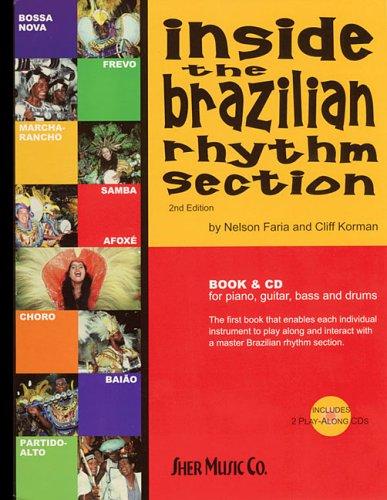
The only play-along that drops you inside a real Brazilian rhythm section — eight grooves, master players, and charts that teach your role, not just your part.
The bottom line
Most “Latin play-alongs” give you a loop, a generic chart, and good luck. This book does something completely different, and to my knowledge nothing else on the market has really replicated it since: it records a genuine, first-call Brazilian rhythm section — Nelson Faria on guitar, Cliff Korman on piano, David Finck and Itaiguara Brandão on basses, Paulo Braga on drums, Café on percussion — playing eight full arrangements in eight distinct Brazilian styles, then hands you two CDs where your instrument has been removed so you can sit in the chair yourself.
The eight styles are samba, bossa nova, partido-alto, choro, baião, frevo, marcha-rancho, and afoxé. That list alone is worth the price. Every jazz musician thinks they can play a bossa; almost none of us, outside Brazil, has ever been asked to play a frevo or a marcha-rancho, and when the gig comes, this is one of very few places to learn what your instrument is actually supposed to do.
The authors state their premise plainly in the Note from the Authors: they wanted “not just short examples of rhythms, or a cyclic harmonic progression meant for improvisation training, but complete arrangements including introduction, multi-part melody, solo section, and a written ending.” That’s exactly what you get — and it’s why the book works. The groove, as they put it, “is a result of the individual parts joining together,” and you learn it by joining.
Who it’s for — and who should skip it
Get it if you play piano, guitar, bass, or drums and you’re an intermediate-or-better jazz musician who wants Brazilian styles to stop sounding like a vague “Latin feel.” It’s equally valuable as a study score: even when I’m not playing along, the transcribed excerpts show how a great section constructs parts. Teachers running combos will get years out of it.
Skip it if you’re a beginner. The lead sheets assume you can already comp, walk, or keep time from a chart — the authors say outright that the parts “are not transcriptions” and that interpreting a basic chart is part of the job. If you’re still building basic comping vocabulary, start with something like Jazz Piano Fundamentals and come back. Also skip it if you’re a horn player or singer (you’re not the audience — there’s no melody-instrument CD), if you want a percussion method (Café’s pandeiro and agogô are on every track but his parts aren’t notated), or if you expect long written explanations. The prose here is lean; the recordings carry the pedagogy.
What’s inside
Every one of the eight chapters follows the same six-part format, which the authors lay out up front:
- General Information — history and key names for the style. These are compact but genuinely informative: the samba chapter traces the style from its roots as “a fusion of maxixe, Afro-Brazilian rhythms found in Bahia and harmonic and melodic influences of choro” through the samba schools of the 1930s and sub-genres like samba-enredo and samba de breque; the choro chapter starts in 1870s Rio with flute, cavaquinho, and the guitars’ contrapuntal baixaria bass lines.
- Underlying Rhythmic Reference — layered diagrams of the essential figures that, felt together, create the groove. This is the conceptual heart of the book.
- Sample Parts — a four-stave mini-score (guitar, piano, bass, drums) showing suggested figures for each section of the tune.
- Form — a roadmap of the arrangement.
- Music — a lead sheet for piano and guitar, plus a bass part and a drum part.
- Performance Notes and Extracted Examples — transcribed excerpts from the actual recordings, with CD timestamps.
The tunes are originals: Brasilified (samba), Rio (bossa nova), Brooklyn High (partido-alto), Saudade do Paulo (choro), Playground (baião), Sombrinhas de Olinda (frevo), Fim de Festa (marcha-rancho), and Montanha Russa (afoxé). These are real compositions with real jazz harmony — Brasilified is a medium-fast samba whose A section alone moves through Cmaj7, Emaj7, and A♭maj7 territory, with a 6/8 section and an open drum solo; Saudade do Paulo opens with a partido-alto intro before turning into a choro, and its solo form ends with bass and drum solos over a G Phrygian vamp.
Each tune appears in five mixes: the full version on both CDs, then CD 1 (for guitar and piano players) gives you no-piano and no-guitar versions, and CD 2 (for drummers and bass players) gives you no-bass and no-drums versions. Café’s percussion stays on every track as the time reference — as the authors note, the patterns “certainly swing harder than a click!” A glossary closes the book, and it’s better than it needs to be: the habanera entry alone connects Cuban danzón, Argentine tango, Brazilian maxixe, ragtime, and New Orleans second-line in one paragraph.
Strengths
- The concept. Learning groove music from notation alone is like learning to swim from a diagram. Playing your part while Braga and Café push you through a form — with intros, backgrounds, and endings — is the closest thing to a Brazilian bandstand you can buy.
- The band. Paulo Braga played on Jobim’s Passarim and with Elis Regina; David Finck’s discography runs from Dizzy Gillespie to André Previn. When the performance notes say to notice how Finck places notes “exactly on the ‘fat part’ of the beat,” you’re studying the real thing. The endorsement page (Kenny Barron, John Patitucci) is deserved for once.
- Timestamped transcriptions. The performance notes point you to exact moments: Finck’s melodic bass part in bars 1–16 of Brasilified (0’00“–0’16“), Korman’s comping at 1’27“–1’44“ analyzed for voice leading and counterpoint. This is how transcription study should be scaffolded.
- A piano philosophy worth the cover price. Korman argues that “guitar-like rhythmic comping should be used sparingly on the piano” — too much sounds choppy — and that when not playing melody he prefers “counter lines, inner voices and legato pads, implying rather than literally stating rhythm motives.” Two decades into playing Latin music, I think this one paragraph would fix half the pianists I hear playing Brazilian tunes.
- Listening curriculum included. The guidelines chapter lists the essential Brazilian pianists, guitarists, bassists, drummers, and composers — from Cesar Camargo Mariano and João Donato to Luizão Maia and Wilson das Neves. Following that list is an education in itself.
Weaknesses
- One tune per style, one tempo per tune. Once you can play Rio comfortably, there’s no faster bossa, no slower samba, no second set of changes. You’ll outgrow the play-along function within months, even though the reference value remains.
- The text is lean to a fault. Performance notes run only a few pages per chapter. Concepts like the 2/4 notation convention, or exactly how partido-alto differs from straight samba in the comping, are demonstrated rather than explained. The book assumes you’ll extract the rest by ear — fair, but be warned.
- Pianists get less prescriptive material than bassists and drummers, who receive fully written parts. Piano and guitar share one lead sheet, and there’s no systematic voicing vocabulary — you’re expected to bring your own from something like The Jazz Piano Book.
- No count-offs on the full-version tracks — the authors acknowledge this themselves. Minor, but you’ll fumble the first few entries.
- It’s a 2001 CD product. If you buy it new today, Sher hosts the audio as downloads, but the book itself never anticipated looping software or slow-downers, which is how most of us would actually practice with it now.
How to actually practice with this book
- Listen to the full version with the lead sheet first and map the form before you play a note. The arrangements have real intros and endings, and with no count-offs you need to know where you enter.
- Clap and sing the Underlying Rhythmic Reference layers — each line separately, then two at once — before touching your instrument. The authors insist the groove is the combination of figures, and they’re right; this is fundamentally an ear skill, not a reading skill.
- Play the sample parts literally, then vary them. Guideline #4 in the book: don’t use the basic motives without variation — “the music comes alive through flow and flexibility rather than with a pre-defined and static rhythmic matrix.” That mindset — assimilate, then let go — is the practical cousin of what Kenny Werner preaches in Effortless Mastery.
- Pianists: treat the two mixes as two different jobs. On the no-piano track the guitar is still comping, so your job is counter-lines and pads around Faria; on the no-guitar track you carry the harmony and rhythm alone. Practicing both teaches you the ensemble awareness that is the book’s whole point.
- Steal the timestamped excerpts. Loop Finck’s eight bars, Korman’s sixteen, until they’re in your hands, then imitate the approach over the other tunes.
- Sharpen the ear the charts assume you have. Because the lead sheets are deliberately bare, comping through Brasilified’s changes at tempo means recognizing chord qualities the instant you see — and hear — them. That recognition speed is exactly what I built Earonman’s chord drills to train, and it pairs naturally with Radley’s ear training method.
How it compares
- vs. Faria’s own The Brazilian Guitar Book (Sher, 1995): deeper and more systematic for guitarists specifically, but it’s a solo method — no band to play inside. Guitarists should own both; everyone else needs this one.
- vs. Brazilian Rhythms for Drumset (Duduka Da Fonseca & Bob Weiner): far more thorough for drummers, with dozens of pattern variations, but drums-only and no play-along interaction of this quality. Drummers: that book for vocabulary, this one for context.
- vs. The Jazz Theory Book: Levine explains harmony brilliantly but treats Brazilian music mostly as repertoire with a “Latin” feel. Faria and Korman teach the part of the music Levine can’t notate.
- vs. Aebersold-style bossa play-alongs: those give you changes to blow over; this gives you a role to play. Different species entirely — Aebersold trains soloists, this trains rhythm sections.
Rating breakdown
| Criterion | Score | Why |
|---|---|---|
| Clarity | 4.5/5 | Identical six-part chapter format throughout; lean prose, but nothing is vague. |
| Depth | 4/5 | Eight styles with real context and master-level examples — but one tune per style and brief notes. |
| Practicality | 5/5 | The five-mix minus-one system and gig-real charts are exactly how this music should be learned. |
| Value | 4.5/5 | A book plus two CDs of a world-class section for the price of half a lesson. |
| Overall | 4.5/5 | The definitive entry point to Brazilian rhythm section playing — irreplaceable, if text-light. |
Check price on Amazon (affiliate link — costs you nothing, keeps the reviews coming)