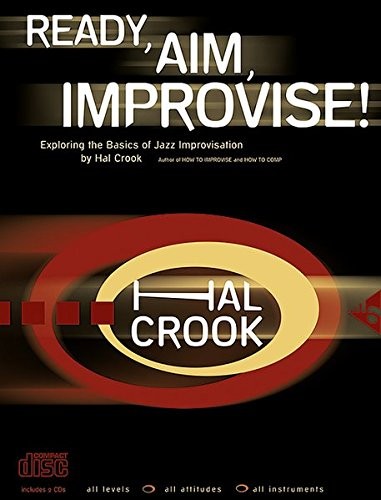
A complete operating system for practicing jazz improvisation — restriction drills, self-recording, honest self-critique — buried in 350 dense, joke-strewn pages.
The bottom line
Hal Crook — trombonist, longtime Berklee improvisation teacher, author of How to Improvise and How to Comp — admits in the postscript that this book took him over seven years to write, and it reads that way: 350 pages containing everything he knows about how a person actually gets better at improvising. His diagnosis, from the preface, is one of the sharpest sentences in jazz pedagogy: most students improvise “as though they are attempting to build their musical houses from the roof down” — technique far ahead of the vocabulary and hearing that should support it. And his conclusion cuts against the talent myth: slow progress usually has less to do with lack of talent than with “confusion about what to practice, how to practice, and — most importantly — how to recognize and critique the musical details” of one’s own playing.
That’s the book in one line. It’s not a lick collection and not a theory text (though it contains both). It’s a practice system: what to isolate, how to drill it, how to record yourself, and how to grade the result against an actual rubric. Twenty-five-plus years on, I still haven’t seen a more complete one between two covers.
Who it’s for — and who should skip it
Get it if you’re a self-directed intermediate or advanced player whose solos have plateaued — especially if you suspect the problem isn’t missing scales but missing skills: pacing, phrasing, time feel, hearing ahead. It’s written for all instruments (play-along materials come in C, B♭, and E♭ parts), and it’s equally valuable for teachers: the assessment charts, development stages, and daily-routine templates in Part Five are a curriculum in a box.
Skip it if you’re a true beginner. Crook lists his prerequisites plainly in the Author’s Notes: at least a year on your instrument, the ability to read music, and familiarity with early jazz styles from listening. Pianists in year one are better served by Jazz Piano Fundamentals first. Skip it too if you want vocabulary handed to you in written-out patterns — that’s Finnerty’s territory — or if long, cross-referenced prose (with a corny joke every third paragraph) makes you put a book down.
What’s inside
Six parts, and the shape matters:
- Part One: Preparation — basic theory, jazz harmony (diatonic and nondiatonic, modulation, harmonic analysis), a superb short chapter on Ear Training (epigraph: “A hungry stomach cannot hear” — La Fontaine), and a chapter on how improvising evolved out of embellishing repertoire. The “Hearing Ahead” section is the sleeper hit: learn a tune’s root-motion line like a melody, play it by ear with eyes closed, then improvise lines landing each chord’s root on beat one — until the harmony sings itself ahead of your hands.
- Part Two: Jazz Vocabulary — the core split of the whole book: Execution (How to Play) — rhythmic feel, accents, dynamics, articulation, vibrato — versus Content (What to Play) — approach notes and target notes, melodic curve, melodic cadence, syncopation, rhythmic density. Chapter 7 compares how these behave in traditional versus modern jazz styles.
- Part Three: Target Practice — isolation drills. Chord-tone soloing before chord-scale soloing; then the famous chapter “Restriction Means Expansion”: single-note (one pitch!) soloing, quarter-note soloing, modal soloing; then key-area soloing over nondiatonic chords (“Inside the Outside Chords”) and a chapter on musical impact.
- Part Four: Extra Help — a Tune File of 300+ standards with difficulty ratings, plus two play-along CDs of single chords, diatonic patterns, modulations, and key-area progressions. The CD index even lists which notes work for single-note soloing on every track.
- Part Five: Practicing — the practice plan, Self-Recording: A Mirror for Your Ears, Self-Critiquing: Accuracy and Musicality with a photocopiable Improvisation Assessment Chart, stages of musical development with matched contexts (e.g., “Autumn Leaves” at ♩ = 112 with bass and drums for an “advanced beginner”), balancing practice against jams and gigs, and daily-routine templates at three levels.
- Part Six: Final Thoughts — Ego and Improvising (For Adults Only), the teacher/student relationship, and “Performing: Know Thy Critic.”
Strengths
- “Restriction means expansion” is the best practice idea in the jazz-book canon. Crook’s analogy: sports get their skill-building power from rules — imagine soccer without goalkeepers. Restrict your solo to one pitch and suddenly pacing, phrase length, rhythmic density, accents, and dynamics are the only music you have; that’s precisely why they finally develop. He’s equally practical about duration: work up to eight- and ten-minute practice solos, because “it is usually necessary to play until you have exhausted what you already know… before you discover something melodically, harmonically or rhythmically new.”
- The chord-tone-first stance. His critique of chord-scale-heavy education is surgical: “chord scales do the work of and for the ear,” which is exactly why novices produce “wandering, shapeless, directionless” eighth-note lines that outline nothing. Chord tones first, “oneness” with the harmony, then scales and approach notes. Coming from a Berklee institution figure, this is refreshingly self-aware.
- The self-assessment loop is the product. Record daily. Critique each chorus separately — accuracy first, then musicality of pacing, content, execution, and technique — on a chart you can photocopy. His pacing rule alone is worth quoting on every practice-room wall: “The frequency and duration of your resting should make the listener want to hear you play, whereas the frequency and duration of your playing should not make the listener want to hear you rest!”
- Honest time horizons. No twelve-week promises. Ear training will take “more time and practice than you can possibly devote to it in one week, or in one month, or even in several months,” and the only improvement is a very small daily amount. His refrain — “the process IS the thing” — is the practice-mindset thesis of the book.
Weaknesses
- It’s dense, sprawling, and constantly cross-referenced. Nearly every section points you to three others (“See 5. EXECUTION, page 93, and 6. CONTENT, page 119”), and the book explicitly leans on How to Improvise and How to Comp — the Author’s Notes call it a study guide for them. It stands alone better than that sounds, but you feel the missing volumes at the edges.
- The humor is a coin flip. Jokes arrive every few paragraphs — dirty laundry under the bed “since Miles Davis recorded Bitches Brew,” royalties gags in the postscript. I mostly enjoy it; some readers will find it padding on an already enormous book.
- The 1999 CDs have aged. Slow single-chord vamps and modulation tracks are perfect for the single-note and key-area drills, and for nothing else — you’ll want iReal Pro or a live rhythm section for tune work. (A newer Advance Music edition swaps the CDs for online audio; the content is the same.)
- Part One is filler if you own a theory text. The scales-intervals-keys material duplicates what The Jazz Theory Book does in more depth.
- Nothing instrument-specific. No voicings, no fingerings; pianists still need The Jazz Piano Book for the instrument itself.
How to actually practice with this book
- Don’t read it front to back. Start in Part Five: photocopy the Improvisation Assessment Chart, find your level in the Stages of Musical Development, and pick the matching musical context. Now you have a baseline.
- Run the daily loop. One topic (say, pacing), one restriction exercise (single-note soloing over a track or a tune from the Tune File at your level), several choruses recorded, then critique each chorus separately on the chart. This 30-minute cycle is the whole book in miniature.
- Do the single-note solo for two weeks before judging it. Play phrases one to three measures long separated by real rests, exaggerate accents and dynamics, stretch solos longer than feels comfortable. It’s humbling and it works.
- Drill “hearing ahead” away from the horn. Learn the root-motion line of one standard per week as if it were a melody, sing it, then play it eyes-closed by ear before adding harmonic rhythm. Since the drill is really interval recognition in disguise, five minutes of focused interval training a day makes the roots arrive in your ear noticeably faster.
- Chord tones before chord scales, exactly in the order of Chapter 8’s exercises — the written chord-tone licks in C, transposed yourself, then approach notes, then scales.
How it compares
- vs. Crook’s own How to Improvise: the earlier book drills deeper on pacing and phrase development; Ready, Aim, Improvise! is broader — vocabulary, ear training, and the entire practicing/self-critique apparatus — and Crook positions it as the foundation. If you’ll realistically buy one Crook book, it’s this one.
- vs. The Jazz Theory Book (Levine): Levine tells you what the notes are; Crook tells you how to turn notes into playing, and how to practice. They don’t overlap so much as complete each other.
- vs. Effortless Mastery (Werner): Crook’s “Ego and Improvising” chapter covers startlingly similar ground — ego turning good and bad solos into superiority and inferiority, his “contest consciousness” — but with jokes and concrete exercises where Werner goes deeper into the psychology alone. Crook in one chapter is the practical digest; Werner is the full retreat.
- vs. The Real Easy Ear Training Book (Radley): Crook’s ear-training chapter is a philosophy plus a to-do list; Radley is the actual course with materials. Use Crook to understand why and how to listen, Radley (or an app) for the daily reps.
- vs. The Serious Jazz Practice Book (Finnerty): Finnerty stocks the pantry with melodic materials; Crook is the operating system that decides what gets cooked, when, and how you taste it. They pair unusually well.
Rating breakdown
| Criterion | Score | Why |
|---|---|---|
| Clarity | 4/5 | Every idea is explained patiently — but the cross-referenced, textbook-dense layout makes you work for it. |
| Depth | 5/5 | Vocabulary, execution, ear training, restriction drills, self-critique, ego — nothing else covers this much of the actual skill. |
| Practicality | 4.5/5 | Photocopiable charts, leveled routines, tune file, exercises on every topic; only the dated play-alongs hold it back. |
| Value | 4.5/5 | A decade of practice direction in one volume; you’ll outgrow the CDs long before the system. |
| Overall | 4.5/5 | The most complete answer in print to “I practice every day — why am I not getting better?” |
Check price on Amazon (affiliate link — costs you nothing, keeps the reviews coming)