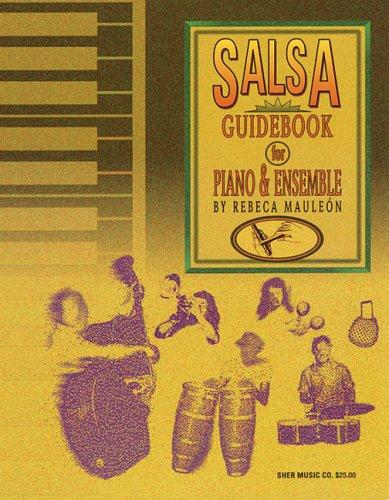
Thirty years on, still the definitive manual on clave, montunos, and how a salsa rhythm section actually locks — bring your own recordings and your own jazz harmony.
The bottom line
I lead a Latin jazz quartet, and this spiral-bound Sher volume is the one book I tell every new member to read — including the horn players. Published in 1993, it remains the clearest single explanation in print of how Afro-Cuban dance music actually works: what the clave is and where it came from, what every instrument in the rhythm section plays against it, and how a salsa arrangement is built so nobody ends up on the wrong side of the pattern.
Mauleón is no academic tourist. She recorded and performed with Tito Puente, Carlos Santana, Cachao, and Poncho Sánchez, and co-directed San Francisco’s Machete Ensemble — and the book reads like it was written on the bandstand. Chapter I states the book’s whole philosophy in one line: “ultimately, we must all be drummers.” That’s the promise, and the book keeps it. It’s also family to this site’s other Sher titles: Mark Levine’s Salsa chapter in The Jazz Piano Book was prepared with Mauleón’s help, and her acknowledgments thank Levine right back.
Who it’s for — and who should skip it
Get it if you’re a jazz musician joining or starting a Latin band — pianist, bassist, drummer, or horn player. It’s equally essential for arrangers: Chapter V is a compact course in salsa form, and the fifteen full score samples show exactly who plays what, stacked vertically. Pianists who loved Levine’s Latin chapter and want the full treatment: this is that book.
Skip it if you can’t yet read rhythmic notation comfortably — the book is wall-to-wall percussion staves and syncopated figures, and there’s no audio to lean on. Skip it too if what you want is jazz harmony and voicings; the montunos here live mostly on I-IV-V and simple progressions, and Mauleón assumes you’ll bring harmonic vocabulary from elsewhere (Levine’s The Jazz Theory Book is the natural pairing). And if you’re chasing modern timba, know that this book’s timeline ends around songo — it documents the tradition up to the early nineties, not what Havana did next.
What’s inside
Two parts, 259 spiral-bound pages, dense with musical figures and wonderful archival photos (Peruchín with his cigar opens the piano section; Machito, Cachao, and Los Muñequitos de Matanzas fill the margins).
- Ch. I, “A Brief Survey of Salsa”: a condensed history — African cultures in the Caribbean, Spanish influences, and the consolidation of rumba, son, and danzón, the forms “virtually all of the material in this book stems from.”
- Ch. II, “Salsa Instruments & Ensembles”: the instruments of Afro-Cuban music plus Puerto Rican and Dominican instruments, and the standard ensemble formats from changüí groups to charangas.
- Ch. III, “The Clave: Its Transformation and Development”: the heart of the book’s pedagogy. Mauleón derives son and rumba clave step by step from the 6/8 clave of Yoruba batá music, explains the tresillo, cinquillo, and the danzón’s baqueteo, defines 3-2 versus 2-3 direction, and names the disease every Latin bandleader fears: being cruzado — crossed with the clave. Short clapping exercises are built in.
- Ch. IV, “Instrument Patterns and Clave”: the longest chapter, and the reason non-pianists need this book too. Tumbadoras, bongos (the martillo), timbales, bell patterns, drumset, hand percussion, then the bass tumbao — root anticipated on beat 4 and tied over the barline, fifth on the “and” of 2, with a Juan Formell line from “Que palo es ese” as a real-world example. Then come thirty-plus pages on the piano montuno: the typical two-bar pattern (“two strong beats and seven up-beats,” derived from tres guitar figures), the rule that the montuno’s downbeat falls on the two-side of the clave, two practical options for starting a montuno in 3-2, accents, right-hand octaves and tenths, and the crucial note that the feel is legato and “should not be interpreted mathematically.”
- Ch. V, “Rhythmic Styles and Structures”: the four cornerstones (son, rumba, danzón, canción), song form — including the arranger’s golden rule that odd-numbered phrases flip the clave direction while even-numbered phrases don’t — a complete sample arrangement roadmap (a son-montuno in 2-3 with a mambo section in 3-2 and an odd-measure cierre to flip back), and fifteen full score samples: son, son-montuno, danzón, afro, cha-cha-chá, mambo, pachanga, güiro, guaguancó, bomba, plena, mozambique, merengue, conga, and songo.
- The reference apparatus: a “Salsa Standards” list every gigging player should photocopy (from “Oye Cómo Va” to “Manteca” and “A Night in Tunisia” filed as mambos), a listening list, a deep discography, a bibliography, and an excellent glossary.
Strengths
- Clave taught as derivation, not dogma. Watching son clave and rumba clave emerge from the 6/8 pattern by dropping two notes is the single most clarifying page sequence I know on the subject. Once you’ve clapped through it, “3-2 versus 2-3” stops being a rulebook and becomes something you hear.
- Everyone’s part, on one page. The score samples show clave, bells, congas, bass, and piano stacked vertically, so you finally see why your montuno has to sit where it sits. No other method book I own does this across fifteen styles.
- The best concise montuno chapter in print. The 2-3/3-2 mechanics are stated plainly, the two entry options for 3-2 montunos solve a problem every jazz pianist hits on the first Latin gig, and the legato warning saves you from the typewriter montunos you hear from classical converts.
- It’s honest about practice. Exercise 1 — clap the clave while tapping the half-note pulse, then switch hands — looks trivial and humbles almost everyone. The exercises are short, physical, and exactly right.
- The reference value compounds. Fifteen years in, I still open the glossary and the standards list more often than most of my “newer” books.
Weaknesses
- No audio, and it shows its age. The introduction promises “a companion cassette tape will soon be available” — that sentence alone dates the book. You must assemble your own listening from the discography, and some of the recordings she recommends take real digging to find.
- Frozen in 1993. Songo is the newest style covered. Timba, the entire modern Cuban school, and three decades of NY salsa evolution are absent. The tradition it documents hasn’t changed; the music since has.
- The history is thin by design. Mauleón herself calls Chapter I “extremely condensed” and points to a fuller companion volume; for real history you’ll need other sources.
- Harmonically basic. The montunos are demonstrated on I-IV-V in C and G. That’s pedagogically correct, but a jazz pianist will exhaust the written harmonic content quickly — her later 101 Montunos (Sher, 1999, with CDs) extends the piano material considerably.
- Notation-heavy. If reading syncopated rhythms is a weakness, this book will fight you on every page.
How to actually practice with this book
- Clave before piano — no exceptions. Do Exercise 1 (clap clave, tap pulse, switch hands, both directions) daily until it’s boring. Then add the bombo — the “and” of beat 2 on the three-side — as the note you feel hardest.
- Montuno against the pulse, then against the clave. Take fig. 4.106 exactly as written, loop it in 2-3 over the I-IV-V progression, foot tapping half notes. Only then move to 3-2 and drill both of Mauleón’s entry options until you can start on either side cold.
- Learn the bass tumbao in your left hand even if you never play bass — root on 4 tied over the barline, fifth on the “and” of 2. Understanding why the downbeat is not played rewires how you hear the whole style.
- Turn the score samples into play-alongs. Program the clave and bell patterns into a sequencer or app, then play the piano part of a different style each week. Learning the conga part at the desk pays off on the bandstand.
- Train the ears alongside the hands. The montuno only grooves when you hear the harmony moving under all that syncopation — I drill blind chord recognition with Earonman’s chords practice so the progressions land in my ears before my hands. If rhythm hearing itself is the bottleneck, Roberta Radley’s The Real Easy Ear Training Book builds that foundation first.
- Photocopy the standards list and learn three tunes from it by ear from the recordings. “Having a few standards under one’s belt,” as she writes, is what makes you employable in a descarga.
How it compares
- vs. The Jazz Piano Book (Levine): Levine’s Salsa/Latin chapter — prepared with Mauleón’s help — is the appetizer; this is the meal. Levine teaches you voicings; Mauleón teaches you where to put them so the timbalero doesn’t glare at you.
- vs. 101 Montunos (Mauleón): her later book is deeper and comes with audio, but it’s piano-only. The Guidebook explains the ensemble and the arranging logic; if you can buy only one, buy this — if you’re a pianist who can buy two, buy both.
- vs. The Latin Real Book (Sher): natural companions — this book explains the styles; the Real Book gives you the charts to apply them on.
- vs. general theory books: nothing here overlaps with The Jazz Theory Book. One covers harmony and line, the other rhythm and role. A working Latin jazz pianist needs both shelves.
Rating breakdown
| Criterion | Score | Why |
|---|---|---|
| Clarity | 4.5/5 | Figure-driven and plainly written; only the notation density slows readers down. |
| Depth | 5/5 | Clave to arranging across fifteen styles and every rhythm-section chair — complete for its era. |
| Practicality | 4/5 | Superb exercises and score samples, but no audio: you must build the listening yourself. |
| Value | 5/5 | A career’s worth of ensemble knowledge; the reference sections alone repay the price. |
| Overall | 4.5/5 | The standard reference on salsa for a reason. Half a point for the missing audio and the 1993 horizon. |
Check price on Amazon (affiliate link — costs you nothing, keeps the reviews coming)