Latin & Brazilian · Jazz Guitar
The Brazilian Guitar Book
Samba, Bossa Nova and Other Brazilian Styles
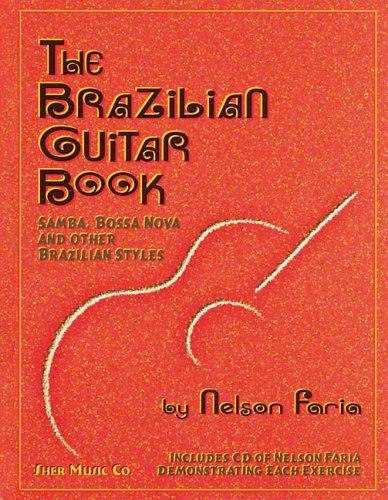
The definitive manual for authentic samba, bossa, partido alto, and baião comping — written for guitar, but the rhythmic truth in it transfers to any comping instrument.
The bottom line
Yes, I’m a pianist reviewing a guitar book. I lead a Latin jazz quartet, and if you play Brazilian music with a guitarist — or instead of one — you need to know exactly what the violão is doing, because everything in the rhythm section is negotiated around it. Nelson Faria’s The Brazilian Guitar Book is the cleanest, most honest codification of that role I’ve found. Faria is the real thing: born in Belo Horizonte, trained at GIT with Joe Diorio and Ted Greene, and a sideman for Milton Nascimento, João Bosco, Ivan Lins, and Toninho Horta — three of whom get their actual guitar parts transcribed in these pages. Toninho Horta himself endorses the book in the front matter, which tells you how it’s regarded in Brazil.
In his opening “Note from the Author,” Faria compares learning a style to learning a language: “You can’t learn everything from a book!! You must hear ‘what it sounds like’ and get the right ‘accent.’” The whole book is built around that idea — every example is demonstrated on the accompanying audio (84 tracks), and each style comes with a listening list of the artists who define it. That humility about what notation can and can’t do is exactly what most “Latin styles” books lack.
Who it’s for — and who should skip it
Buy it if: you’re an intermediate-to-advanced guitarist who wants to comp samba and bossa nova that Brazilians would recognize as samba and bossa nova; you’re a pianist, bassist, or drummer working in Brazilian settings who wants to understand the guitar’s role (the rhythmic layer transfers directly — more on that below); or you’re an arranger who needs authentic rhythm-section figures for five distinct styles instead of one generic “Latin feel.”
Skip it if: you’re a beginner. You need solid barre chords, basic fingerstyle technique, and the ability to read syncopated sixteenth-note rhythms before this book gives you anything. There’s no tablature — just notation plus chord “stamps” (fingerboard grids). Also skip it if you’re looking for improvisation material: this is a comping and rhythm book, full stop. There are no scales, no soloing concepts, no licks. And if you want a songbook of Jobim standards, this isn’t that either — the full tunes are mostly Faria originals plus three chord-melody arrangements.
What’s inside
The book (143 pages, spiral-bound) is organized into five parts — Samba, Bossa Nova, Choro, Frevo, and Baião — and every part follows the same architecture:
- General Outline — a compact history and a “Musical Characteristics” section. The samba chapter traces the style to early-1900s Rio, São Paulo, and Bahia (“Pelo telefone,” the first recorded samba, 1917) and defines the subdivisions: samba enredo, samba canção, samba de breque, partido alto, batucada, samba-funk. The bossa chapter pins the style’s birth to “Chega de Saudade” (March 1959) and shows the harmonic clichés — the same Dm7–G7–Cmaj7 phrase reharmonized as Dm9–Db9–C6/9, Dm9–Abm6–Cmaj9/G, and Am6–Abº(b13)–C6/9/G.
- Basic Pattern and Variations for Rhythm Guitar — the heart of the book. The right-hand system is explained once and used everywhere: the thumb plays the bass on the beat (switching root and fifth, preferably the fifth below the root), while fingers 1–2–3 play the syncopated top voices, simulating the percussion section. Samba gets seventeen variations, bossa six, choro five, frevo five, baião seven.
- Song, accompaniment, and chord melody examples — each part ends with an original Faria tune as a lead sheet, then the same tune with the comping written out measure by measure, plus a chord-melody arrangement (“Tristeza” for samba, Jobim’s “Triste” for bossa, Helio Delmiro’s “Marceneiro Paulo” for choro).
The transcriptions are the hidden treasure. The bossa basic pattern isn’t an abstraction — it’s João Gilberto’s actual intro to “Insensatez” from the 1961 EMI-Odeon album. Samba Variation #7 is the partido alto pattern, and Faria backs it up with two João Bosco transcriptions: “Incompatibilidade de Gênios” (from Galos de Briga, RCA 1976) and the first 22 measures of “Coisa Feita.” There are further excerpts from Toninho Horta (“Aquelas Coisas Todas”), Ivan Lins (“Desesperar Jamais”), Joyce (“Feminina”), Luiz Bonfá (“Batukada”), Oscar Castro Neves, and Roberto Menescal.
The audio ends with something quietly brilliant: tracks 75–84 are isolated percussion patterns — tamborim and pandeiro playing samba, ganzá and claves playing bossa, surdo playing frevo, triangle, cowbell, and zabumba playing baião. Ten tracks of pure feel reference, played by percussionist Marco Lobo.
Strengths
- It teaches the logic, not just the licks. The samba outline shows how a plain quarter-note figure progressively syncopates, beat by beat, into the rhythmic cliché “you’ll find in almost every samba melody” — with melody excerpts from “Desafinado” and Milton’s “Cravo e Canela” (a 3/4 samba) as evidence. Once you see the derivation, you can generate your own variations instead of memorizing seventeen.
- Every pattern maps to a percussion instrument. Variation #1 simulates the agogô by alternating low and high chord voices; a baião variation puts a cowbell pattern in the top voice against a syncopated bass. This is what makes the book transfer beyond guitar: it’s really a book about how the Brazilian percussion section works, encoded for two hands. At the piano, Faria’s thumb becomes my left hand and his fingers 1–2–3 become my right, and the patterns work almost unchanged.
- The transcriptions keep it honest. When the “textbook” pattern sits next to what João Bosco actually recorded in 1976, you can measure the distance between exercise and art.
- Five styles, not one. Frevo, choro (Variation #2 nods to Villa-Lobos’s Choros No. 1), and baião (Luiz Gonzaga territory: mixolydian and lydian b7 melodies over pedal tones, zabumba and triangle) rarely get serious treatment in English-language books.
Weaknesses
- The prose is thin. Each “General Outline” is a page or so. You get what and how, but little why — no voice-leading analysis of the voicings, no deeper cultural history. Pair it with real listening (Faria’s own artist lists point the way).
- Demonstration audio only. Every example is played, beautifully, but there are no slow versions and no play-along tracks minus guitar. For a rhythm book, that’s a real gap — you’ll be making your own loops.
- Partido alto is undersold. It’s one variation inside the samba chapter. On bandstands today it’s practically its own dialect, and I’d happily trade a couple of frevo pages for a dedicated partido alto section.
- Samba-funk is named in the subdivisions list but never gets a pattern. Same for maracatu and afoxé — outside the book’s scope entirely.
- It shows its 1995 age. The English is charmingly rough in spots, and there’s even a note explaining how CD players with “track time” displays handle tracks above #20. None of this affects the content.
- Guitar-specific packaging. The chord stamps are useless to non-guitarists; you’ll be reading dense two-voice rhythmic notation and translating. Doable — I did it — but know what you’re signing up for.
How to actually practice with this book
Faria’s own instructions are the right ones, so follow them literally. First, isolate the rhythm: practice each pattern with the left hand muting the strings (pianists: tap it on the closed lid), and practice away from the instrument, “clapping hands on the high voices and tapping the low voices with your foot.” Second, apply the pattern to simple 6/9 and m9 grips over II–V progressions and turnarounds before touching a tune. Third — and this is where the book becomes special — loop the isolated percussion tracks (75–84) and comp against the tamborim or surdo until the counterpoint locks. Fourth, take one variation through an entire song, then start switching variations at section boundaries, which Faria notes is how it’s actually done. Give each style two to four weeks. And do it with your ears leading: sing the top-voice syncopation before you play it, the same discipline Roberta Radley’s ear training book builds — Faria’s “get the right accent” advice is ultimately an ear-training assignment.
How it compares
Against Mark Levine’s The Jazz Theory Book, there’s no overlap and total complementarity: Levine gives you the harmonic vocabulary (and a Salsa/Latin chapter that barely touches Brazil); Faria gives you the rhythmic delivery system. Pianists who know the comping chapters of The Jazz Piano Book will find Faria answers the question Levine leaves open — when exactly those voicings should sound in a Brazilian groove. The natural sequel is Faria’s own Inside the Brazilian Rhythm Section (with Cliff Korman, also Sher), which adds piano and bass parts plus proper play-along tracks — it fixes this book’s biggest gap, but it assumes you already have the guitar-side vocabulary codified here. Antonio Adolfo’s Brazilian Music Workshop (Faria performed on it) covers more styles more broadly but with less depth per instrument. For comping authority in Brazilian styles, this book still has no real rival thirty years on.
Rating breakdown
| Category | Score | Why |
|---|---|---|
| Clarity | 5/5 | One right-hand system explained once, applied consistently across five styles; clean notation with chord stamps and audio for every example. |
| Depth | 4/5 | Seventeen samba variations plus real transcriptions is serious depth, but the historical/theoretical prose is thin and partido alto deserves more. |
| Practicality | 5/5 | Every page is playable material; the isolated percussion tracks and written-out song accompaniments go straight to the bandstand. |
| Value | 4.5/5 | 143 spiral-bound pages, 84 audio tracks, transcriptions of Gilberto/Bosco/Horta — only the lack of play-along tracks keeps it from full marks. |
| Overall | 4.5/5 | The reference for Brazilian comping, earned. |
Check price on Amazon (affiliate link — costs you nothing, keeps the reviews coming)